
When you've spent decades working in architectural visualization and design — translating blueprints into photorealistic worlds, building atmosphere from nothing, making a client feel what a space will be like before a single wall is raised — you develop a particular relationship with the tools of your craft. And you learn to recognize when a conversation about those tools is missing the point.
That's where we are with AI right now.
Across the design industry, I'm watching the same split I've seen before: those who have handed the creative process over entirely, and those who are holding their ground, waiting for the wave to pass. Both are reacting from the same place. Fear.
Two Reactions, One Root Cause
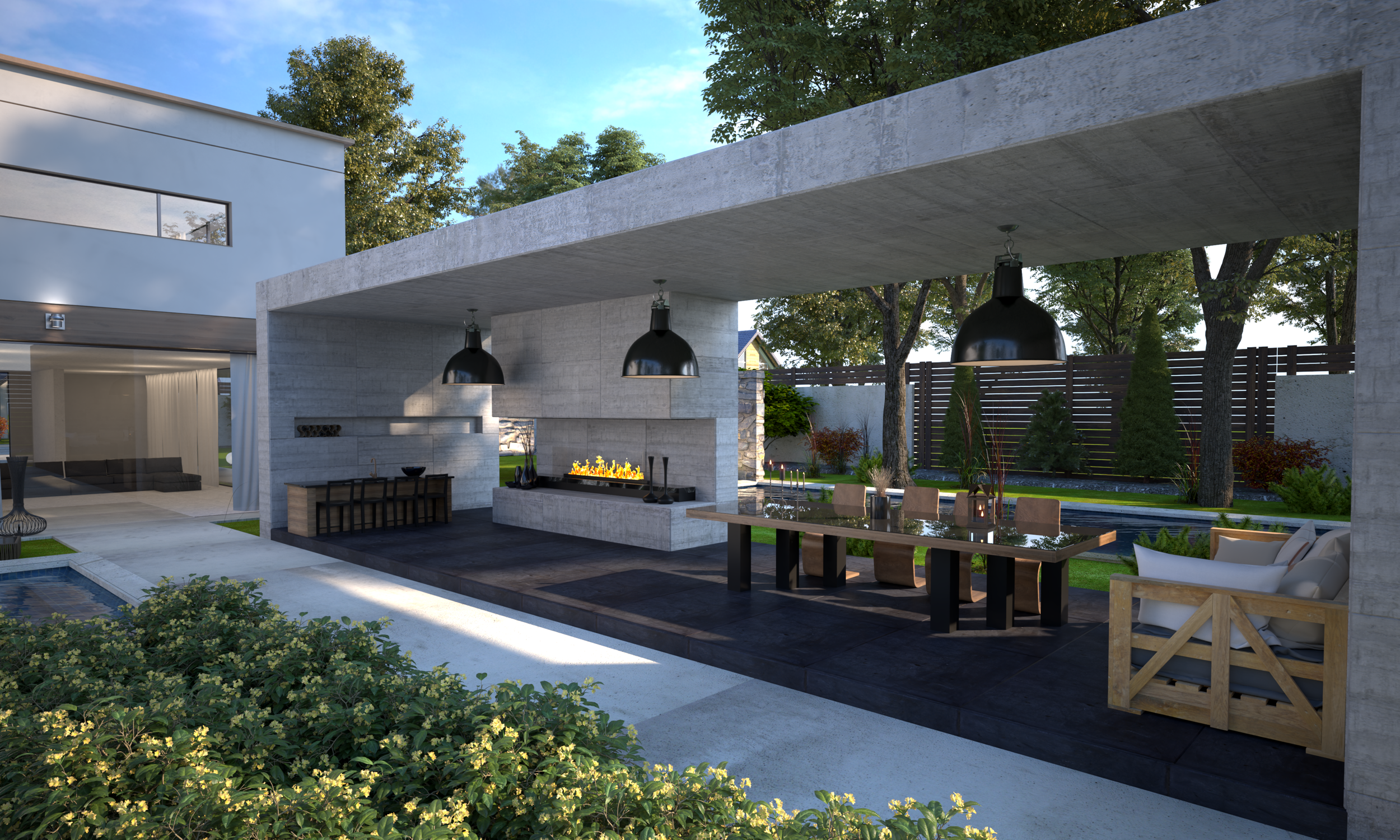
In architectural visualization, the stakes of this conversation are concrete. Our work isn't decoration — it's a communication tool. When we deliver a hero image for a luxury resort or a cinematic walkthrough of a residential development, that visual is doing real work: helping investors commit, helping architects refine, helping clients understand what they're building before construction begins.
The first camp looks at AI image generation and sees an accelerant. Generate fast, iterate endlessly, cut the timeline. But what gets lost in that approach is everything that actually makes a visualization trustworthy: the deep reading of architectural drawings, the understanding of how light behaves differently on travertine versus glass, the camera storytelling choices that communicate how a guest will actually experience a lobby. These things aren't steps in a workflow. They are the work.
The second camp sees AI as a threat to that craft and shuts the door entirely. I understand the instinct. When your professional identity is built around spatial intelligence and visual judgment earned over years, a tool that appears to replicate it feels personal. But avoidance is not a strategy. It is a delay that puts you further behind, not further ahead.
"Both camps are reacting to the tool before they've understood it. The designers who navigate this well will be the ones who stayed curious long enough to ask the right questions."
What Our Process Actually Requires
At S&S Design Studio, our process moves through five deliberate stages: Discovery, Concept, Modeling & Texturing, Lighting & Rendering, and Delivery. Each of those stages carries a kind of intelligence that isn't reducible to a prompt.
Discovery means understanding the architecture, the brand vision, and the design intent at a level that takes conversation and experience to access. Concept means developing a visual direction and camera story — deciding what angle tells the truth about a space, what time of day reveals its character, what detail deserves emphasis. Modeling and texturing means building accurate 3D environments from architectural drawings where precision is non-negotiable. Lighting is where atmosphere is made — where a render moves from technically correct to emotionally resonant.
None of that lives in a model. It lives in the people who have done it, failed at it, refined it, and done it again across hundreds of projects.

The Third Option
There is a path between surrender and refusal, and it's the one most of the industry conversation glosses over: educate yourself, stay curious, and make a deliberate choice about what you keep and what you delegate.
In our work, creative process is identity. The moment you hand over the visual judgment — the decision about how light falls on a façade at dusk, or which camera angle makes a resort feel like an arrival and not just a building — you've handed over the thing clients are actually paying for. That is not a process I have any desire to automate. It is the work that makes the work worth doing.
But I'm also honest about what fills a professional studio's week beyond those moments. File management. Format exports. Preliminary brief documentation. Reference gathering. First-pass research for a new project type. These are the hours that drain creative energy without feeding it. If AI can compress those, it doesn't diminish the visualization. It protects the time and attention the visualization actually needs.
"AI is not here to replace the designer's vision. It is here to give that vision more room to operate."
What This Means for Visualization Specifically
For studios doing high-end architectural and hospitality visualization, the implications are more nuanced than the general industry conversation acknowledges. Our clients — architects, developers, luxury hospitality brands — are not buying renders. They are buying the ability to communicate a vision with confidence. That confidence comes from accuracy, atmosphere, and the kind of visual storytelling that only happens when someone deeply understands both the architecture and the audience.
AI-generated imagery, at its current state, can produce something that looks like an architectural rendering. It cannot produce something that is one — built from actual drawings, faithful to material specifications, and crafted to serve a specific presentation or marketing purpose. The gap between those two things is where professional visualization lives, and it is not closing as fast as the headlines suggest.
That said, the studios that engage with AI tools thoughtfully — understanding what they can and cannot do — will be better positioned than those who either chase every new output tool or refuse to learn the landscape at all.
The Designers Who Navigate This Well
Every significant shift in this industry — from hand drafting to CAD, from CAD to 3D, from static renders to animation and real-time walkthrough — was met with the same two reactions. And every time, the professionals who came out stronger were not the most resistant or the most compliant. They were the most curious.
They asked what the tool could do. They found its edges. They decided with intention where it served the work and where it didn't. Then they got back to the part that no tool replaces: vision, craft, and the ability to make a client feel something before the first foundation is poured.
That is still our job. It has always been our job. The tools change. That doesn't.
